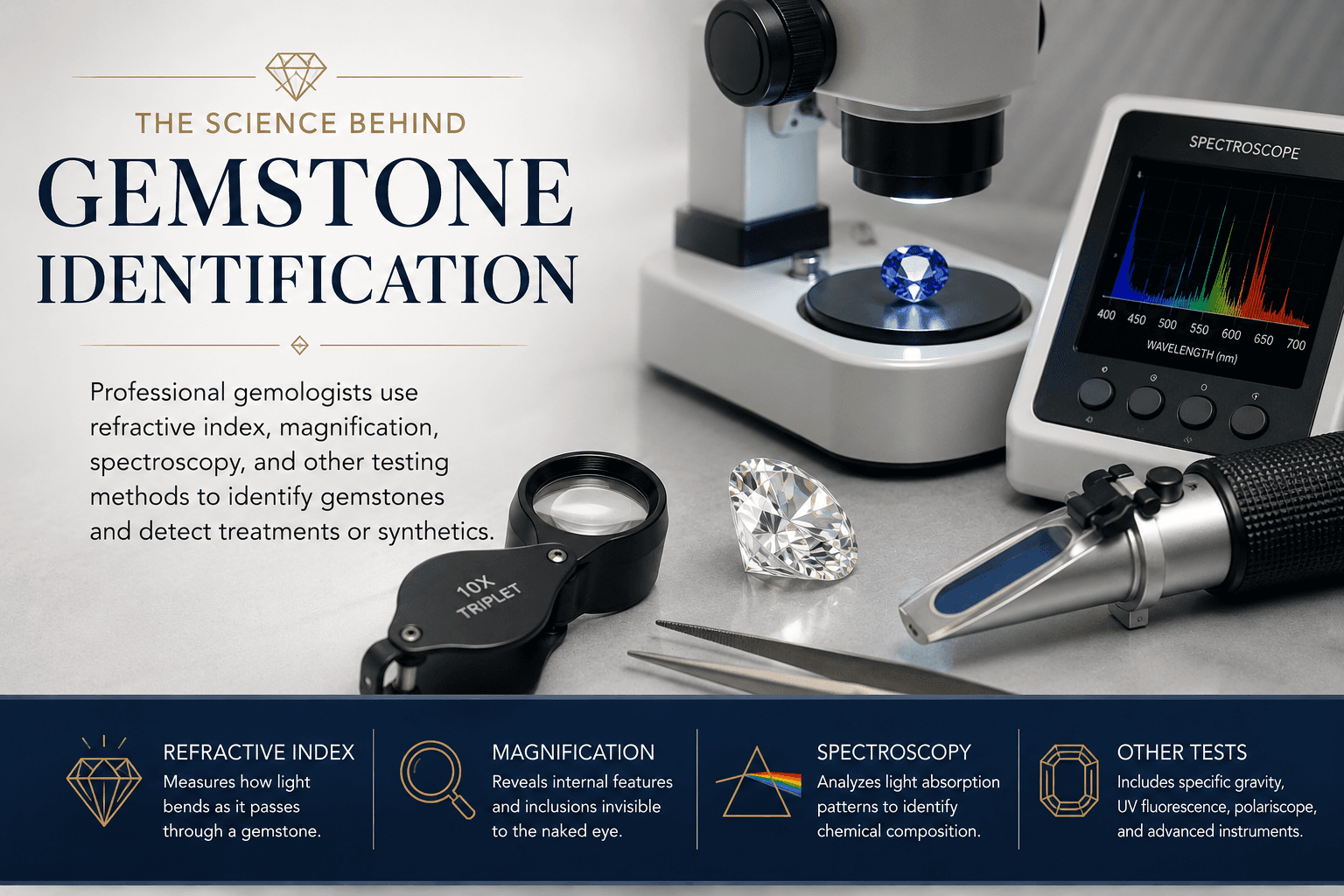
At first glance, identifying a gemstone may appear to be a matter of recognizing its color and appearance. In professional gemology, however, identification is a much more systematic process. Gemologists use a combination of observations, measurements, instruments, and reference information to determine what a gemstone is and whether it is natural, synthetic, treated, or an imitation.
The goal is not simply to find one test that produces an answer. Instead, gemological identification is often a process of elimination and confirmation. Different tests reveal different physical or optical properties, and the results are compared until they form a consistent identification.
Why Gemstone Identification Requires Multiple Tests
Many gemstones can look remarkably similar. A blue stone, for example, could belong to several different species or could even be a synthetic or glass imitation. Color alone is therefore rarely enough to establish identity.
Professional identification combines several characteristics such as refractive index, birefringence, optical character, specific gravity, pleochroism, absorption spectrum, fluorescence, and internal features.
No single observation should automatically determine the identity of a gemstone. Confidence comes from multiple independent observations that support the same conclusion.
Initial Visual Examination
The examination normally begins with careful observation. The gemologist considers the gemstone's color, transparency, luster, shape, cutting style, and overall appearance.
This first stage helps establish a working hypothesis, but it is not normally considered sufficient for a final identification. Experienced gemologists may recognize familiar visual characteristics quickly, but instruments and measurements are still required to confirm the conclusion.
Refractive Index
Refractive index (RI) describes how strongly a material bends light. Because different gemstone materials have characteristic refractive-index ranges, RI is one of the most useful starting points for identification.
A refractometer is commonly used to measure RI when the gemstone's cut and transparency allow an appropriate reading. The result is compared with established gemological reference data.
RI can help separate gemstones that look similar but have significantly different optical properties. It can also provide information about whether a gemstone is singly or doubly refractive.
Single and Double Refraction
Many gemstones are either singly refractive or doubly refractive. In a singly refractive material, light behaves differently from a doubly refractive material as it travels through the crystal.
Observing this optical behavior can narrow the list of possible identities considerably. Some gemstones can also show anomalous optical behavior, which is why this observation should be interpreted together with other tests.
Specific Gravity
Specific gravity describes the density of a gemstone relative to water. Since different gem materials have different densities, specific gravity can be a useful identification property.
For suitable loose gemstones, gemologists can use methods such as hydrostatic weighing. The measured result is then compared with the expected range for possible materials.
Specific gravity is particularly valuable when used alongside RI and other observations because a combination of properties can greatly narrow the possible identification.
Microscopic Examination
Magnification provides one of the most fascinating sources of information in gemology. Under a microscope, a gemstone can reveal internal features that are invisible to the unaided eye.
Natural gemstones may contain mineral crystals, fluid inclusions, healed fractures, growth structures, color zoning, and other features formed during geological growth.
Some examples include:
- Three-phase inclusions can be an important diagnostic feature in certain natural emeralds.
- Curved growth structures may help indicate certain synthetic manufacturing processes.
- Gas bubbles can be characteristic of glass or other manufactured imitations.
- Growth zoning can provide clues about the conditions under which a crystal formed.
Microscopic features are not simply imperfections. They can act as a record of the gemstone's formation history and can provide important evidence during identification.
Spectroscopy
A gemstone's interaction with light can provide another important identification clue. A spectroscope or more advanced spectroscopic instrument can reveal wavelengths that are absorbed by the material.
These absorption patterns can be related to specific elements or structural characteristics within the gemstone. In some cases, the resulting spectrum can help distinguish between gemstones that have very similar visual appearances.
Fluorescence and Other Optical Observations
Some gemstones respond to ultraviolet radiation by producing visible fluorescence. The presence, absence, color, and intensity of fluorescence can provide supporting evidence.
Other observations may include pleochroism, which refers to different body colors being visible in different crystallographic directions. These observations can be especially useful when combined with RI and microscopic examination.
Natural, Synthetic, Treated, or Imitation?
Identification is not limited to determining the gemstone species. A professional examination may also investigate whether the material is natural, synthetic, treated, or an imitation.
A natural gemstone formed through geological processes. A synthetic gemstone has essentially the same chemical composition and crystal structure as its natural counterpart but was produced through a laboratory process. An imitation merely resembles another gemstone in appearance and may be made from a completely different material.
Treatments add another layer to the examination. Heat treatment, filling, irradiation, dyeing, diffusion, and other processes may alter a gemstone's appearance or properties.
The Importance of Combining Evidence
Suppose a gemstone has an RI consistent with several possible species. That result alone may not provide a final answer. The gemologist can then consider specific gravity, optical character, microscopic features, absorption spectrum, and other observations.
When these results consistently point toward the same identity, confidence increases. If they contradict one another, the gemologist investigates further rather than forcing a conclusion.
Documentation and Laboratory Reports
Once identification has been established, the relevant observations can be documented in a gemological report. Depending on the type of report, this may include gemstone identity, measurements, weight, color, treatment observations, and other descriptive information.
Proper documentation is especially useful when gemstones are being traded, insured, appraised, catalogued, or submitted for further examination.
Final Thoughts
Gemstone identification is a science of observation, measurement, comparison, and interpretation. The most reliable conclusions come from multiple tests that support one another rather than from a single visual characteristic.
For anyone learning gemology, understanding why each instrument is used is just as important as learning the names of the instruments. Refractive index, magnification, specific gravity, spectroscopy, and optical observations each provide a different piece of the puzzle.
When those pieces agree, the gemologist can arrive at a well-supported identification and document the result with confidence.
Want a lab deep-dive on this?
Our team can explain the exact scientific tests, microscopic observations, and reporting logic behind any topic covered here.
Inquire with the Academy