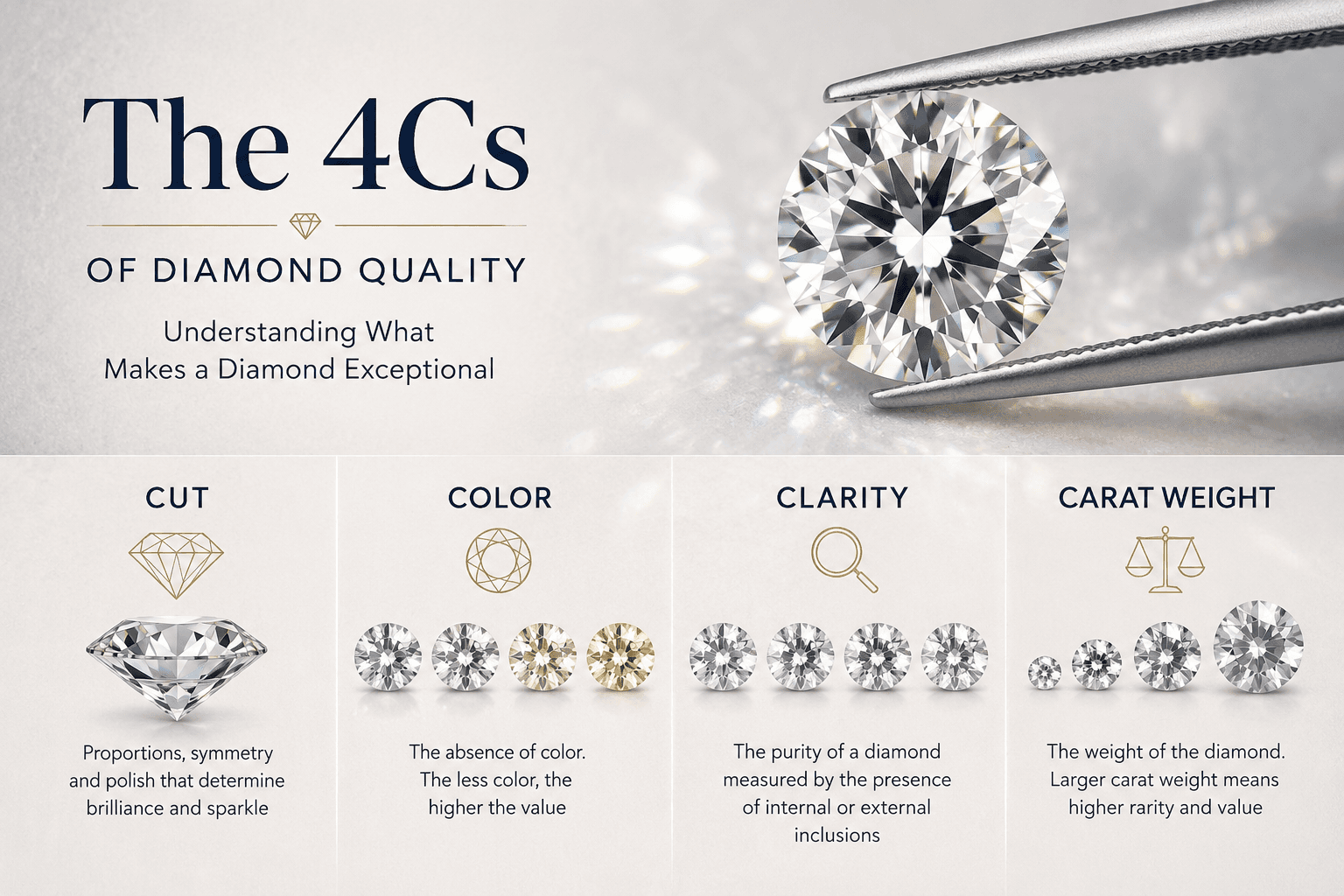
When people begin learning about diamonds, one of the first terms they encounter is the 4Cs: Cut, Color, Clarity, and Carat Weight. These four characteristics form the foundation of modern diamond grading and provide a common language for describing a diamond's quality.
Understanding the 4Cs is important whether you are buying a diamond, evaluating an existing stone, studying gemology, or simply trying to understand what is written on a diamond grading report. A diamond's appearance and value are not determined by one characteristic alone. Instead, the 4Cs work together to describe different aspects of the stone.
It is also important to remember that the 4Cs are not a simple scoring system where a diamond with the highest grade in every category is automatically the best choice. Two diamonds with different combinations of grades can have very similar visual appearances, while a diamond with impressive grades on paper may not look as attractive as expected if its proportions and light performance are poor.
What Are the 4Cs?
The four characteristics are:
- Cut — how effectively the diamond's proportions and facets interact with light.
- Color — the degree of body color present in a diamond.
- Clarity — the presence, size, position, and visibility of internal inclusions and external blemishes.
- Carat Weight — the actual weight of the diamond.
Each C describes something different. Cut primarily influences visual performance, color describes body color, clarity describes internal and surface characteristics, and carat weight describes mass. Together they create a much more complete description of a diamond.
1. Cut: The Way a Diamond Handles Light
One of the most common misunderstandings about diamond grading is confusing cut with shape. Round, oval, pear, emerald, princess, and marquise are examples of diamond shapes. Cut, on the other hand, concerns how well the diamond's proportions, symmetry, and facet arrangement allow it to interact with light.
When light enters a well-cut diamond, it can be reflected internally and returned toward the observer. This produces the visual effects that make diamonds appear bright and lively.
Brightness, Fire, and Scintillation
Diamond appearance is often discussed in terms of three major visual effects. Brightness refers to the amount of white light returned from the diamond. Fire describes flashes of spectral colors created when white light is dispersed. Scintillation refers to the pattern of flashes seen as either the diamond or the observer moves.
A poorly proportioned diamond may allow too much light to escape through the pavilion or other areas instead of returning it toward the observer. This can make the stone appear dark, dull, or less lively even when its color and clarity grades are high.
Of the 4Cs, cut has a particularly strong influence on a diamond's visible beauty because it directly affects how the stone interacts with light.
2. Color: Understanding the D-to-Z Scale
For most colorless diamond grading, color is evaluated using a scale that begins at D and progresses toward Z. D represents the highest end of the traditional colorless range, while progressively lower grades show increasing amounts of yellow or brown body color.
The differences between adjacent grades can be subtle, especially when diamonds are viewed individually. This is why professional color grading is performed under controlled lighting conditions and with standardized comparison methods.
Why Does Color Matter?
Color can influence both appearance and rarity. Diamonds with very little detectable body color are relatively uncommon, while diamonds further down the traditional D-to-Z scale display increasingly noticeable warmth.
However, the most desirable color grade depends on the diamond, its cut, shape, setting, and personal preference. Some diamond shapes can show body color more readily than others, and a warm-colored diamond can also be intentionally selected for its character.
3. Clarity: Reading a Diamond's Internal Characteristics
Clarity describes the internal and external characteristics observed in a diamond. Internal characteristics are commonly called inclusions, while surface characteristics are called blemishes.
Diamonds form deep within the Earth under extreme geological conditions. During their formation and growth, various natural characteristics can develop inside the crystal. These characteristics can provide valuable information to a gemologist and help distinguish one diamond from another.
The traditional clarity scale includes:
- FL — Flawless: no inclusions or blemishes visible under the specified grading conditions.
- IF — Internally Flawless: no internal inclusions visible under the specified grading conditions.
- VVS1–VVS2 — Very, Very Slightly Included: inclusions are difficult to see even under magnification.
- VS1–VS2 — Very Slightly Included: inclusions are minor and require magnification to evaluate clearly.
- SI1–SI2 — Slightly Included: inclusions are more noticeable under magnification and may sometimes be visible without it.
- I1–I3 — Included: inclusions are generally more obvious and may affect transparency, durability, or appearance.
Clarity should not be judged simply by the number of inclusions. Their size, position, color, relief, type, and overall effect on the diamond are also important considerations.
4. Carat Weight: Measuring Diamond Weight
Carat is a unit of weight, not a direct measurement of size. One carat equals 0.2 grams, and a carat is divided into 100 points. For example, a diamond weighing 0.50 carat can also be described as 50 points.
Two diamonds with the same carat weight can have different dimensions depending on their shape and proportions. This is why carat weight alone does not tell you exactly how large a diamond will appear when viewed from the top.
Why Does Price Increase With Carat Weight?
Larger diamonds are generally rarer than smaller diamonds of comparable quality. Because of this rarity, price does not increase in a perfectly linear manner as carat weight increases.
Popular weight thresholds can also have an effect on market pricing. A diamond weighing just under one carat may be priced differently from a one-carat diamond even when their other characteristics are similar.
How the 4Cs Work Together
The most useful way to understand diamond grading is to consider the four characteristics together rather than evaluating each one in isolation.
For example, a diamond with extremely high clarity but mediocre cut may not appear as lively as a diamond with slightly lower clarity and a significantly better cut. Similarly, increasing carat weight may make a diamond larger, but it does not automatically make the stone more beautiful.
This is why diamond evaluation requires balance. The ideal combination depends on the purpose of the diamond, its shape, setting, budget, and the visual characteristics that matter most to the buyer.
Why a Grading Report Matters
A professional grading report provides an independent description of the characteristics observed in a diamond. Depending on the laboratory and report type, it can include information about the 4Cs, measurements, proportions, fluorescence, clarity characteristics, and other relevant observations.
A report makes it easier to compare diamonds using documented information rather than relying entirely on descriptions such as "premium," "excellent quality," or other marketing terminology.
Final Thoughts
The 4Cs provide a structured way to understand diamond quality, but they should be viewed as a complete system rather than four isolated scores. Cut influences light performance, color describes body color, clarity describes natural characteristics, and carat weight records the diamond's mass.
Once you understand how these characteristics interact, reading a diamond report becomes much easier. More importantly, you can make decisions based on documented gemological information rather than appearance or marketing language alone.
Want a lab deep-dive on this?
Our team can explain the exact scientific tests, microscopic observations, and reporting logic behind any topic covered here.
Inquire with the Academy